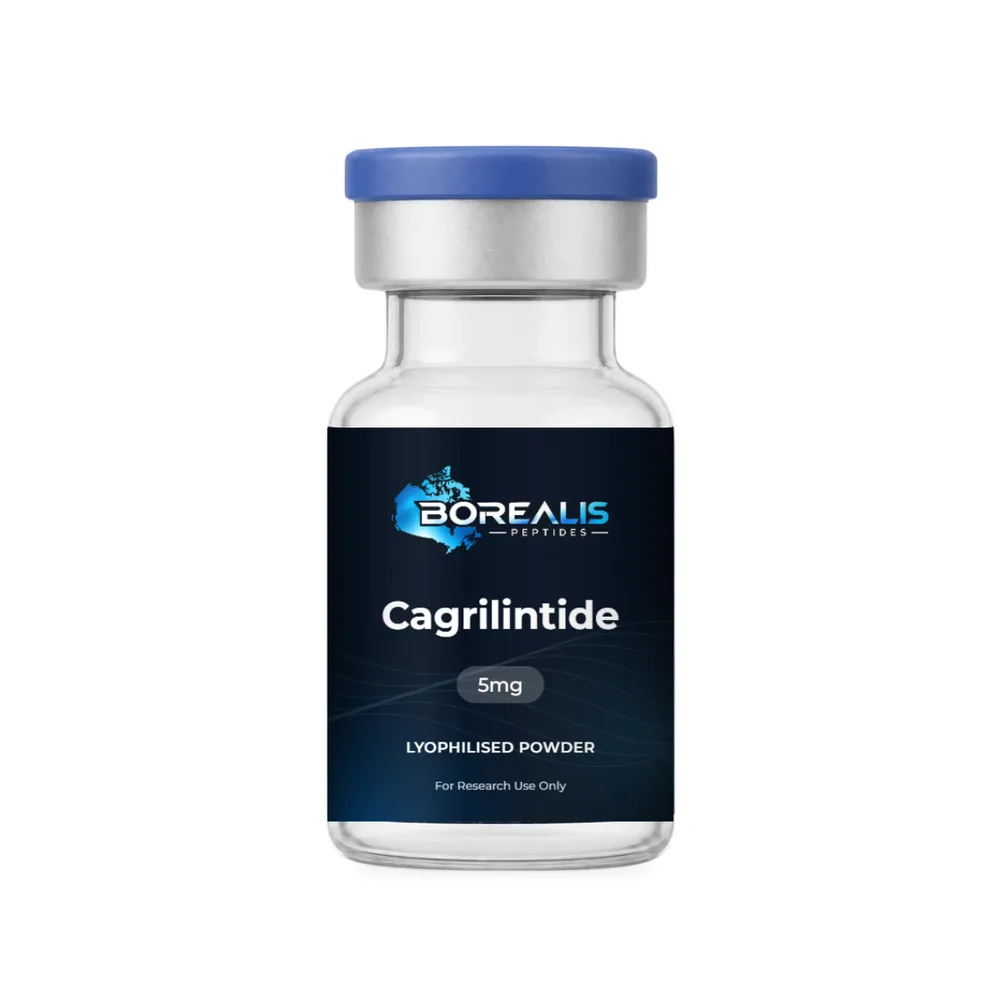


- Also known as
- Cagri · cagrilintide peptide · long-acting amylin analogue · CagriSema component
- Class
- Long-acting amylin analogue (amylin receptor agonist)
- Form
- Lyophilised powder in 5 mg and 10 mg vials
- Sizes
- 5 mg · 10 mg
- Storage, dry
- −20 °C, dry and dark
- Storage, mixed
- 2–8 °C, use within 28 days of mixing (as generally reported for reconstituted peptides)
- BAC water per size
- 5 mg: 2 mL · 10 mg: 2 mL
What is Cagrilintide?
Cagrilintide is a long-acting amylin analogue (amylin receptor agonist), and that classification is where the published work starts. Published work on it is in human. The name covers the same material written several ways in the literature, including Cagri, cagrilintide peptide and long-acting amylin analogue. Its sequence is recorded as Amylin analogue modified for a long half-life; most trials pair it with semaglutide (CagriSema). 8 of the 8 studies listed below are controlled trials in people. It is stocked here as lyophilised powder in 5 mg and 10 mg vials, for laboratory work only. It is not a medicine and is not for use in humans or animals.
What the research shows
| Study | Model | Dose used | Duration | Finding |
|---|---|---|---|---|
| Lau DCW et al.2021 · Lancet · PMID 34798060 | Human, phase 2 randomised controlled trial, cagrilintide alone, adults with overweight or obesity without diabetes (n=906 randomised: 706 cagrilintide, 99 liraglutide, 101 placebo) | Cagrilintide 0.3, 0.6, 1.2, 2.4 or 4.5 mg once weekly, subcutaneous; comparator liraglutide 3.0 mg once daily | 26 weeks treatment (including up to 6 weeks escalation), plus 6 weeks follow-up | Mean weight reduction was 6.0%–10.8% across the cagrilintide doses versus 3.0% with placebo (trial product estimand). Cagrilintide 4.5 mg reduced weight by 10.8% compared with 9.0% for liraglutide 3.0 mg. |
| Gabe MBN et al.2024 · Diabetes Obes Metab · PMID 39279639 | Human, randomised double-blind thorough QT study, cagrilintide alone, healthy participants (n=105) | Cagrilintide once weekly subcutaneous, escalated to 4.5 mg; placebo arms received moxifloxacin 400 mg as a positive control | Not stated in the abstract | No clinically relevant QTcF prolongation occurred after the last 4.5 mg dose; the upper limits of the 90% confidence intervals of the placebo-adjusted changes were below 10 ms at all time points. |
| Enebo LB et al.2021 · Lancet · PMID 33894838 | Human, phase 1b randomised placebo-controlled trial, cagrilintide + semaglutide 2.4 mg, otherwise healthy adults with BMI 27.0–39.9 (n=96 randomised, 95 exposed) | Cagrilintide 0.16, 0.30, 0.60, 1.2, 2.4 or 4.5 mg or placebo, each with semaglutide 2.4 mg, once weekly subcutaneous | Co-escalation over 16 weeks, 4 weeks at target dose, then 5 weeks follow-up | The primary endpoint was the number of treatment-emergent adverse events; 566 adverse events were reported in 92 participants. Pharmacokinetics, body weight, glycaemic measures and hormones were secondary or exploratory endpoints. |
| Frias JP et al.2023 · Lancet · PMID 37364590 | Human, phase 2 randomised double-blind trial, CagriSema vs semaglutide vs cagrilintide, type 2 diabetes on metformin (n=92) | CagriSema, semaglutide or cagrilintide, each escalated to 2.4 mg once weekly subcutaneous | 32 weeks | HbA1c fell by 2.2 points with CagriSema, 1.8 with semaglutide and 0.9 with cagrilintide alone. Body weight fell by 15.6%, 5.1% and 8.1% respectively; CagriSema beat both single agents on weight. |
| Garvey WT et al.2025 · N Engl J Med · PMID 40544433 | Human, phase 3a randomised controlled trial (REDEFINE 1), CagriSema vs each component vs placebo, adults with overweight or obesity without diabetes (n=3417) | Cagrilintide 2.4 mg + semaglutide 2.4 mg, semaglutide 2.4 mg, cagrilintide 2.4 mg, or placebo, once weekly | 68 weeks | Mean body weight change was −20.4% with CagriSema versus −3.0% with placebo (difference −17.3 percentage points). The abstract does not report the result for the cagrilintide-alone arm. |
| Davies MJ et al.2025 · N Engl J Med · PMID 40544432 | Human, phase 3a randomised placebo-controlled trial (REDEFINE 2), CagriSema, adults with overweight or obesity and type 2 diabetes (n=1206) | Cagrilintide 2.4 mg + semaglutide 2.4 mg or placebo, once weekly | 68 weeks | Mean body weight change was −13.7% with CagriSema versus −3.4% with placebo. HbA1c of 6.5% or less was reached by 73.5% versus 15.9%. |
| Yamauchi T et al.2026 · Lancet Diabetes Endocrinol · PMID 42009015 | Human, phase 3a randomised active-controlled trial (REDEFINE 5), CagriSema vs semaglutide, adults in Japan and Taiwan with or without type 2 diabetes (n=331) | Cagrilintide + semaglutide or semaglutide alone, both escalated to 2.4 mg once weekly subcutaneous | 68 weeks | Mean body weight change was −18.4% with CagriSema versus −11.9% with semaglutide alone (difference −6.5 percentage points). |
| Rosenstock J et al.2026 · Lancet · PMID 42251856 | Human, phase 3a randomised placebo-controlled trial (REIMAGINE 3), CagriSema added to basal insulin, type 2 diabetes (n=274) | Cagrilintide 2.4 mg + semaglutide 2.4 mg, or 1.0 mg + 1.0 mg, or dose-matched placebo, once weekly subcutaneous | 40 weeks | HbA1c fell by 2.33 points (2.4 mg each) and 2.10 points (1.0 mg each) versus 0.66 points with placebo. |
What these studies don't show: Controlled human data exists, but it is limited in scope. Who was enrolled, what was measured and for how long all constrain what the results mean. Safety beyond those trial conditions remains unestablished. Knowing the vial holds what the label says is not the same as knowing the compound does anything.
Every study links to its PubMed record. See all Cagrilintide studies in the research library →
Cagrilintide price in Canada: 5mg and 10mg vials
Buy Cagrilintide in Canada in 2 vial sizes and a starter kit. Prices are in Canadian dollars, you pay by Interac e-Transfer or bank transfer, and orders are shipped from Canadian stock.
| Size | Price | Per mg |
|---|---|---|
| 5 mg | $43.00 | $8.60/mg |
| 10 mg | $85.50 | $8.55/mg |
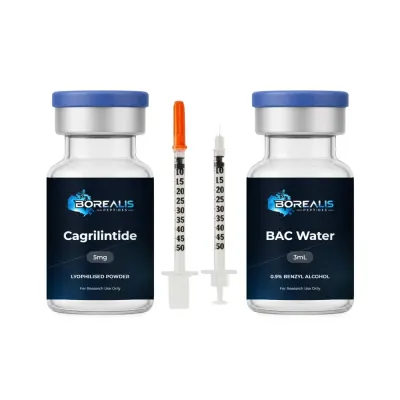
Starter kit
Is Cagrilintide available in Canada?
Cagrilintide does not appear in the Drug Product Database as an authorized product. It has had no safety, efficacy or quality review from Health Canada. It is stocked here as laboratory research material and for no use in a person or an animal. How Health Canada treats research peptides →
Side effects reported in studies
Each statement is tied to the study that reported it. Any tolerability finding below is quoted from the study that reported it. Human work of this size does not establish a safety profile.
Doses used in studies
Cagrilintide FAQ
What is Cagrilintide?
Suppliers and the literature both list Cagrilintide as a long-acting amylin analogue (amylin receptor agonist). The published work on it is in human. Borealis Peptides supplies it as lyophilised powder in 5 mg and 10 mg vials for in-vitro laboratory research. It is not a medicine and is not for use in humans or animals. The studies behind it are listed on this page with the model each used and what the authors reported.
Where can I buy Cagrilintide in Canada?
It ships within Canada from stock we hold, in 5 mg and 10 mg vials. Nothing leaves without HPLC confirmation of identity and purity for that batch. Borealis Peptides accepts research orders only, and ships to research and business addresses.
Is Cagrilintide legal in Canada?
Cagrilintide does not appear in the Drug Product Database as an authorized product. It has had no safety, efficacy or quality review from Health Canada. It is stocked here as laboratory research material and for no use in a person or an animal. Health Canada has said that "Research Use Only" labelling does not make a product legal to use in a person, so we treat it as a description of what the material is supplied for rather than a permission.
How much Cagrilintide should I use?
Borealis Peptides gives no dosing, protocols or reconstitution volumes, and will not provide them on request. In laboratory work the amount follows from the study design, which a supplier cannot sensibly set. The figures on this page are what specific published studies used in their own models: a record of what was done, not a recommendation.
What human evidence is there for Cagrilintide?
Of the 8 studies cited, 8 are controlled trials in people and the rest are animal or cell work. Each row names its model, the amount used and what the authors reported, so the weight of each study can be judged directly rather than through a summary.
Does Cagrilintide need refrigeration?
Unopened, keep it at −20 °C in the dark. In solution it is kept at 2–8 °C. Because the dry form is stable at room temperature, shipping needs no cold chain; refrigerate it when it arrives. Repeated freeze-thaw cycles and light exposure are the real risks, not the shipping.
How is the purity of Cagrilintide confirmed?
Identity and purity are confirmed by HPLC for each batch, not once per product. The certificate names the batch it belongs to, and that batch number is on the vial, so a result can be traced back to the exact material that produced it. Ask with your order number and we send it.
How does Cagrilintide compare with Retatrutide and Tirzepatide?
They are different compounds with different published records, and this site does not rank them. Retatrutide and Tirzepatide have 6 cited studies and 8 cited studies on their page against 8 here. The useful comparison is between the two study tables and the models behind them.
Compare with
Related compounds


AOD-9604
Modified C-terminal fragment of human growth hormone
Add 2 more to save 4%