
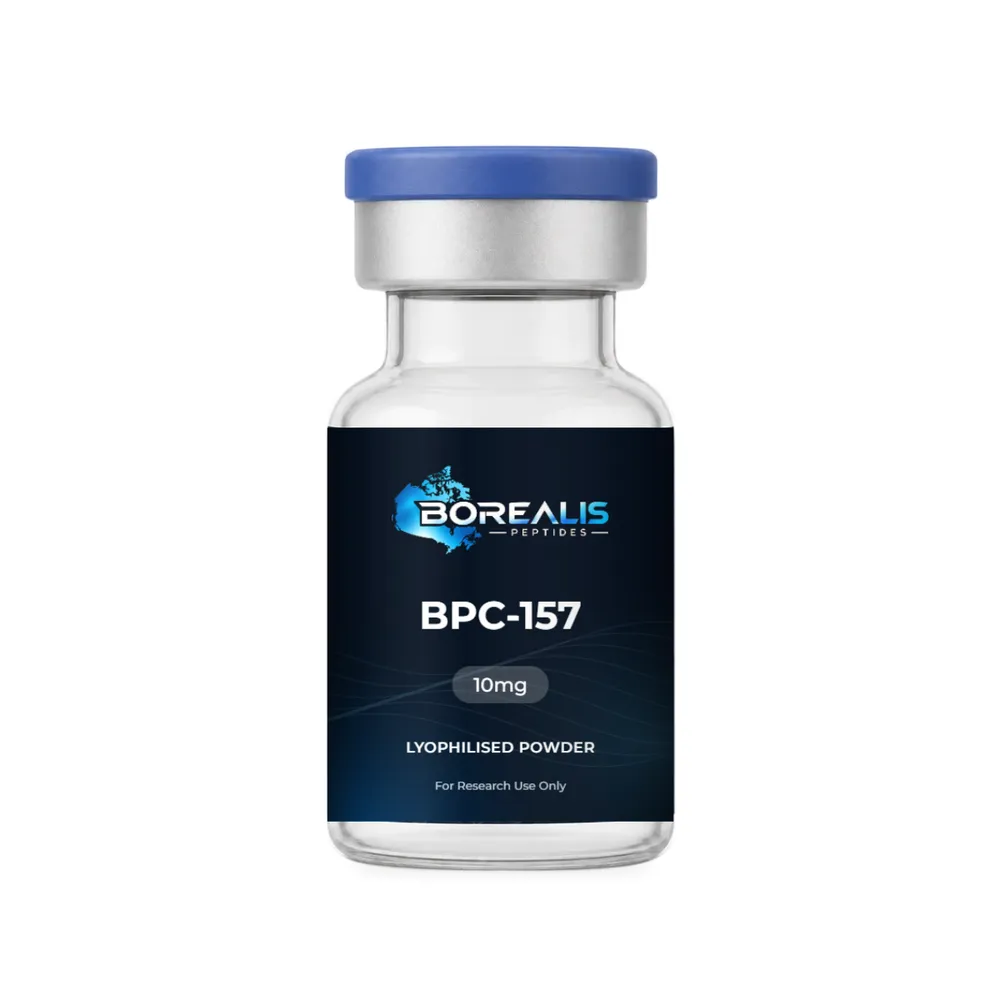


- Also known as
- BPC 157 · BPC157 · Body Protection Compound 157 · stable gastric pentadecapeptide
- Class
- Synthetic pentadecapeptide derived from a gastric protein
- Form
- Lyophilised powder in 10 mg vials and capsules
- Sizes
- 10 mg
- Storage, dry
- −20 °C, dry and dark
- Storage, mixed
- 2–8 °C, use within 28 days of mixing (as generally reported for reconstituted peptides)
- BAC water per size
- 10 mg: 2 mL
- Molecular weight
- 1419.5 g/mol
What is BPC-157?
BPC-157 is a synthetic pentadecapeptide derived from a gastric protein. The chain runs to 15 amino acids. The name covers the same material written several ways in the literature, including BPC 157, BPC157 and Body Protection Compound 157. Its sequence is recorded as Gly-Glu-Pro-Pro-Pro-Gly-Lys-Pro-Ala-Asp-Asp-Ala-Gly-Leu-Val (15 residues). Its molecular weight is 1419.5 g/mol. Published work on it is in rat, human and enzyme assay in vitro. People have received it in 3 studies, none of them controlled, which means those results cannot separate the compound from everything else that changed. Supplied as lyophilised powder in 10 mg vials and capsules, held in Canadian stock, for laboratory research. Nothing here is a medicine; it is not for human or veterinary use.
What the research shows
| Study | Model | Dose used | Duration | Finding |
|---|---|---|---|---|
| Lee E et al.2024 · Altern Ther Health Med · PMID 39325560 | Human, uncontrolled pilot study (n=12 women with interstitial cystitis), private clinic | 10 mg total, given by injection around the inflamed area of the bladder during cystoscopy | Single procedure; follow-up period not stated in the abstract | Ten of 12 patients reported complete resolution of symptoms and 2 of 12 rated their success at 80% on the Global Response Assessment. No adverse events were reported. The study had no control group. |
| Lee E et al.2021 · Altern Ther Health Med · PMID 34324435 | Human, retrospective chart review with phone survey (n=16, knee pain) | Intra-articular BPC-157 alone (n=12) or with thymosin beta-4 (n=4); amount not stated in the abstract | Most patients surveyed 6 months to 1 year after the injection | Eleven of 12 patients given BPC-157 alone reported significant improvement in knee pain, and 14 of 16 overall reported relief. No specific tools were used to measure function or quality of life. |
| Lee E et al.2025 · Altern Ther Health Med · PMID 40131143 | Human, safety pilot (n=2 adults), private clinic | 10 mg in 250 cc normal saline over one hour on day 1, then 20 mg on day 2 (intravenous) | 3 days | The infusions produced no measurable effects on the tested heart, liver, kidney and thyroid biomarkers or blood glucose, and no side effects were reported. |
| Perovic D et al.2019 · J Orthop Surg Res · PMID 31266512 | Rat, spinal cord compression injury model | 200 or 2 μg/kg, one intraperitoneal injection 10 min after injury | Assessed at 1, 4, 7, 15, 30, 90, 180 and 360 days | All injured rats given BPC-157 showed better tail motor function, no autotomy and resolved spasticity by day 15, with less axon loss, oedema and motoneuron loss on microscopy. |
| Duzel A et al.2017 · World J Gastroenterol · PMID 29358856 | Rat, ischaemic colitis and reperfusion model | 10 μg/kg as a bath (1 mL/rat) on the blood-deprived colon segment | 15 min vessel recording; day 10 in the colon obstruction group | BPC-157 increased vessel presentation and collateral connections, and MDA and NO levels were normal in treated rats. On day 10 the obstructed segments showed almost completely spared mucosa. |
| Zivanovic-Posilovic G et al.2016 · Eur J Pharmacol · PMID 27815173 | Rat, bupivacaine cardiotoxicity model; HEK293 cells | 50 µg/kg, 10 µg/kg, 10 ng/kg or 10 pg/kg intraperitoneal, 30 min before or 1 min after bupivacaine; 1 µM in cells | Not stated in the abstract | BPC-157 largely counteracted bupivacaine-induced arrhythmias, AV block and asystole, and given after QRS prolongation it markedly postponed the fatal outcome. In HEK293 cells it inhibited bupivacaine-induced depolarisation. |
| Jelińska J et al.2026 · Int J Mol Sci · PMID 42278509 | Enzyme assay in vitro (acetylcholinesterase, modified Ellman assay) | Not stated in the abstract | Not applicable (enzyme kinetics) | BPC-157 acted as a reversible competitive acetylcholinesterase inhibitor (Ki = 0.48 mM; IC50 = 2.80 mM), with significantly lower potency than clinically used inhibitors. |
What these studies don't show: Every human study listed lacks a control arm. With nothing to compare against, cause cannot be separated from coincidence. Group sizes are small and follow-up is short, so they do not establish long-term safety. Testing establishes identity and purity; it is not evidence of an effect.
Every study links to its PubMed record. See all BPC-157 studies in the research library →
BPC-157 price in Canada: 10mg vial
Buy BPC-157 in Canada in a 10mg vial, plus capsules and a starter kit. Prices are in Canadian dollars, you pay by Interac e-Transfer or bank transfer, and orders are shipped from Canadian stock.
| Size | Price | Per mg |
|---|---|---|
| 10 mg | $52.00 | $5.20/mg |
Other formats and kits
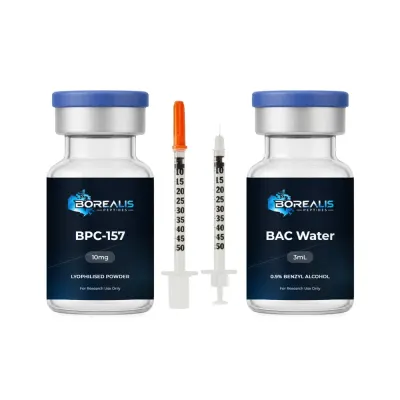
Is BPC-157 available in Canada?
Canada has no authorized BPC-157 product: no DIN has been issued for it. Nothing about its safety, efficacy or quality has been reviewed by a regulator here. It is stocked here as laboratory research material and for no use in a person or an animal. Read more →
Side effects reported in studies
The studies cited below report what they observed on tolerability, and those statements are reproduced as written. Human work of this size does not establish a safety profile. Read more →
BPC-157 FAQ
What is BPC-157?
BPC-157 is a synthetic pentadecapeptide derived from a gastric protein. The published work on it is in rat, human and enzyme assay in vitro. Borealis Peptides supplies it as lyophilised powder in 10 mg vials and capsules for in-vitro laboratory research. It is not a drug, and it is not supplied for use in a person or an animal. Every reference here is listed with the model it ran in and the finding as published.
Where can I buy BPC-157 in Canada?
It ships within Canada from stock we hold, in 10 mg vials. Nothing leaves without HPLC confirmation of identity and purity for that batch. Borealis Peptides accepts research orders only, and ships to research and business addresses. Each batch carries its own HPLC analysis, tied to the number printed on the vial.
Is BPC-157 legal in Canada?
Canada has no authorized BPC-157 product: no DIN has been issued for it. Nothing about its safety, efficacy or quality has been reviewed by a regulator here. It is stocked here as laboratory research material and for no use in a person or an animal. Health Canada has said that "Research Use Only" labelling does not make a product legal to use in a person, so we treat it as a description of what the material is supplied for rather than a permission.
How much BPC-157 should I use?
Borealis Peptides gives no dosing, protocols or reconstitution volumes, and will not provide them on request. In laboratory work the amount follows from the study design, which a supplier cannot sensibly set. The figures on this page are what specific published studies used in their own models: a record of what was done, not a recommendation.
What human evidence is there for BPC-157?
There is human work, but none of it is controlled. 3 studies involved people, as pilots, case reports or retrospective reviews. Without a control group these cannot show that the compound caused what was observed, and the page says so beside the table.
How long does BPC-157 keep?
Sealed vials are held at −20 °C, dry and out of the light. Once reconstituted, 2–8 °C. It travels at room temperature as a dry powder and goes cold on arrival. Light and repeated warming do more damage than the journey.
Does BPC-157 need bacteriostatic water?
The capsules are a dry oral format and take no liquid. Only the lyophilised vial is supplied dry, and that is the one format bacteriostatic water applies to. It is sold separately. Each batch carries its own HPLC analysis, tied to the number printed on the vial.
How is the purity of BPC-157 confirmed?
Identity and purity are confirmed by HPLC for each batch, not once per product. The certificate names the batch it belongs to, and that batch number is on the vial, so a result can be traced back to the exact material that produced it. Ask with your order number and we send it.
How does BPC-157 compare with TB-500 and Wolverine blend (BPC-157 + TB-500)?
These are separate compounds with separate literatures; no ranking is offered here. TB-500 and Wolverine blend (BPC-157 + TB-500) have 7 cited studies and 8 cited studies on their page against 7 here. The useful comparison is between the two study tables and the models behind them.
Why is BPC-157 named in a Health Canada advisory?
Because it was among the peptides seized from sellers offering unauthorized injectable products online. The advisory concerns material sold for people to inject without authorization. Borealis Peptides supplies research material for laboratory use and sells nothing for injection or for any use in a person, which is the line that advisory draws.
Compare with
Related compounds

Wolverine blend (BPC-157 + TB-500)
Two-peptide research blend: a gastric pentadecapeptide and a thymosin beta-4 related peptide
Add 2 more to save 4%
GHK-Cu
Copper-binding tripeptide (Gly-His-Lys copper complex)
Add 2 more to save 4%
KPV
Melanocortin-derived tripeptide (C-terminal fragment of α-MSH)
Add 2 more to save 4%