
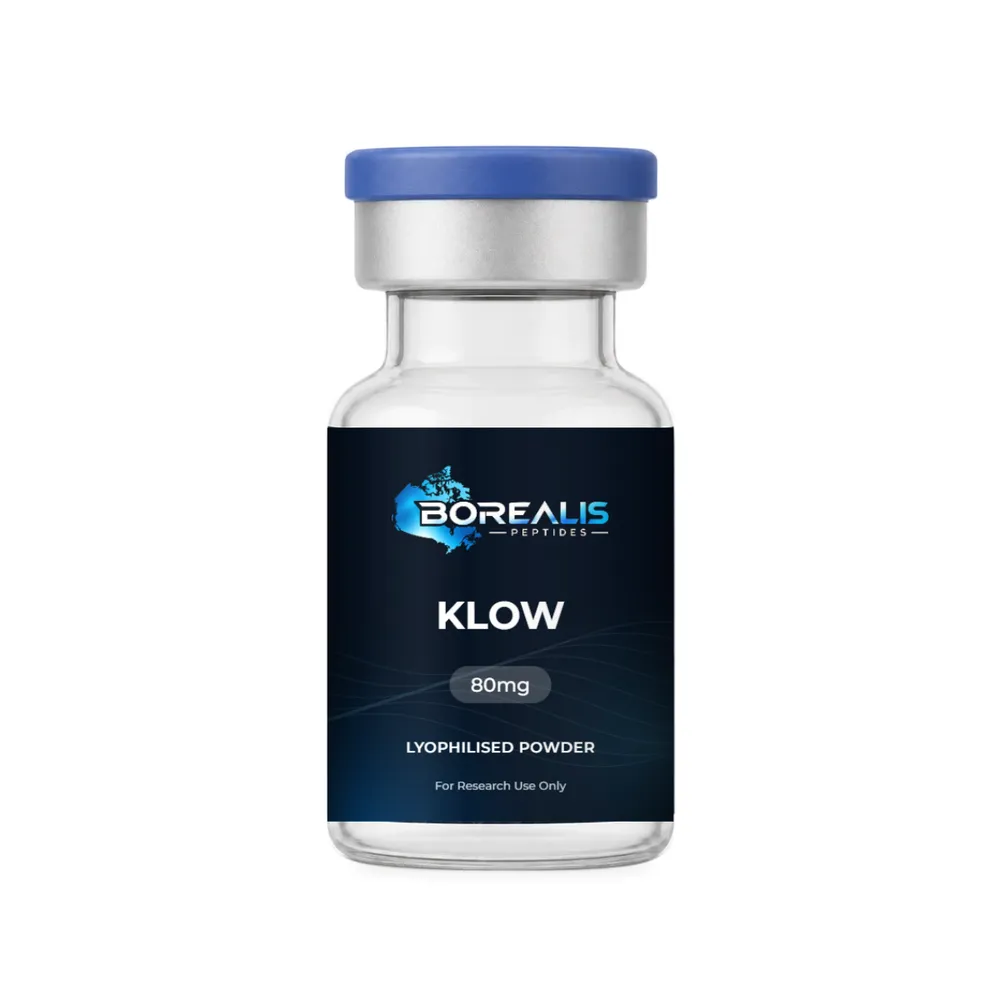


- Also known as
- KLOW blend · KLOW peptide · GLOW + KPV · GHK-Cu, BPC-157, TB-500 and KPV blend · KLOW stack · KLOW peptide stack
- Class
- Four-peptide research blend (GHK-Cu, BPC-157, TB-500, KPV)
- Form
- Lyophilised powder in 80 mg vials
- Sizes
- 80 mg
- Storage, dry
- −20 °C, dry and dark
- Storage, mixed
- 2–8 °C, use within 28 days of mixing (as generally reported for reconstituted peptides)
- BAC water per size
- 80 mg: 5 mL
What is KLOW?
KLOW is a single vial holding GHK-Cu 50 mg, BPC-157 10 mg, TB-500 10 mg and KPV 10 mg as one lyophilised powder. The two are studied separately in the literature, and the studies cited on this page are those separate studies. The chain runs to 15 amino acids. Published work on it is in rat, human and mouse. One of the 8 studies listed below is a controlled trial in people. We hold it as lyophilised powder in 80 mg vials; it is research material and nothing else. Nothing here is a medicine; it is not for human or veterinary use.
What the research shows
| Study | Model | Dose used | Duration | Finding |
|---|---|---|---|---|
| Miller TR et al.2006 · Arch Facial Plast Surg · PMID 16847171 | Human, randomised controlled trial (n=13 completed), skin after CO2 laser resurfacing | Topical skin care products with or without GHK-Cu; concentration not stated in the abstract | 12 weeks | Computer analysis and blinded evaluators found no significant difference between groups in erythema, wrinkles or overall skin quality. On the patient questionnaire, rated improvement in overall skin quality was higher in the GHK-Cu group (P = .04). |
| Lee E et al.2021 · Altern Ther Health Med · PMID 34324435 | Human, retrospective chart review with phone survey (n=16, knee pain) | Intra-articular BPC-157 alone (n=12) or with thymosin beta-4 (n=4); amount not stated in the abstract | Most patients surveyed 6 months to 1 year after the injection | Eleven of 12 patients given BPC-157 alone reported significant improvement in knee pain, and 14 of 16 overall reported relief. No specific tools were used to measure function or quality of life. |
| Deng M et al.2023 · J Cachexia Sarcopenia Muscle · PMID 36905132 | Mouse (C57BL/6), cigarette-smoke muscle dysfunction model; C2C12 muscle cells; plasma GHK measured in people with COPD (n=9) and healthy controls (n=11) | 0.2 and 2 mg/kg (route not stated in the abstract) | Not stated in the abstract | GHK-Cu reduced smoke-induced loss of muscle mass and improved grip strength (175.5 g untreated vs 257.6 g and 339.1 g). Plasma GHK was lower in the COPD group than in controls (70.27 vs 133.0 ng/mL). |
| Perovic D et al.2019 · J Orthop Surg Res · PMID 31266512 | Rat, spinal cord compression injury model | 200 or 2 μg/kg, one intraperitoneal injection 10 min after injury | Assessed at 1, 4, 7, 15, 30, 90, 180 and 360 days | All injured rats given BPC-157 showed better tail motor function, no autotomy and resolved spasticity by day 15, with less axon loss, oedema and motoneuron loss on microscopy. |
| Li Y et al.2025 · J Allergy Clin Immunol · PMID 39978686 | Mouse, house dust mite allergic asthma model (BDCA2-DTR mice); cell experiments | Tβ4 supplementation; amount not stated in the abstract | Not stated in the abstract | Tβ4 supplementation reversed the worsened asthma phenotype in mice depleted of plasmacytoid dendritic cells. Tβ4 inhibited IL-4/IL-13-induced JAK1/STAT6 signalling and CCL2 expression in macrophages. |
| Maar K et al.2025 · Int J Mol Sci · PMID 40362372 | Mouse, permanent coronary ligation (heart attack) model; human cardiac cells | Systemic TB4 injection; amount not stated in the abstract | Not stated in the abstract | TB4 raised miR139-5p expression and modulated ROCK1 protein levels in mouse hearts and human cardiac cells, and may reverse or inhibit fibroblast-to-myofibroblast transformation. |
| Dalmasso G et al.2008 · Gastroenterology · PMID 18061177 | Mouse, DSS- and TNBS-induced colitis models; human intestinal epithelial cells (Caco2-BBE, HT29-Cl.19A) and T cells (Jurkat) | Nanomolar concentrations in cells; in mice, KPV added to drinking water (amount not stated in the abstract) | Not stated in the abstract | Nanomolar KPV inhibited NF-κB and MAP kinase signalling and reduced pro-inflammatory cytokine secretion, acting through the PepT1 transporter. Oral KPV reduced the incidence of DSS- and TNBS-induced colitis in mice. |
| Kannengiesser K et al.2008 · Inflamm Bowel Dis · PMID 18092346 | Mouse, DSS colitis and CD45RBhi transfer colitis models, including mice with a nonfunctional MC1 receptor | Not stated in the abstract | Not stated in the abstract | KPV gave earlier recovery and stronger regain of body weight, with fewer inflammatory infiltrates and lower colonic MPO activity. In MC1R-deficient mice, KPV rescued all treated animals from death during DSS colitis. |
What these studies don't show: There are controlled trials, though they answer narrow questions. Who was enrolled, what was measured and for how long all constrain what the results mean. None of it establishes safety outside the conditions each trial ran under. Knowing the vial holds what the label says is not the same as knowing the compound does anything.
Every study links to its PubMed record. See all KLOW studies in the research library →
KLOW price in Canada: 80mg vial
Buy KLOW peptide stack in Canada in an 80mg vial and a starter kit. Prices are in Canadian dollars, you pay by Interac e-Transfer or bank transfer, and orders are shipped from Canadian stock.
| Size | Price | Per mg |
|---|---|---|
| 80 mg | $129.00 | $1.61/mg |
Starter kit

Is KLOW available in Canada?
KLOW does not appear in the Drug Product Database as an authorized product. No regulatory assessment of its safety, efficacy or quality has been carried out in Canada. It is stocked here as laboratory research material and for no use in a person or an animal. How Health Canada treats research peptides →
Side effects reported in studies
Absence of a reported effect in a small study is not evidence of safety. Each statement is tied to the study that reported it. None of the cited abstracts states a tolerability finding for KLOW. Read more →
Doses used in studies
KLOW FAQ
What is KLOW?
KLOW is a four-peptide research blend (GHK-Cu, BPC-157, TB-500, KPV), and that classification is where the published work starts. The published work on it is in rat, human and mouse. Borealis Peptides supplies it as lyophilised powder in 80 mg vials for in-vitro laboratory research. It is not authorized as a medicine and is not for use in any living subject. The studies behind it are listed on this page with the model each used and what the authors reported.
Where can I buy KLOW in Canada?
Borealis Peptides ships KLOW from Canadian stock to research and business addresses in Canada. It is held in 80 mg vials. Every batch is tested by HPLC and the certificate names the batch in your vial. Orders are accepted for laboratory research only.
Is KLOW legal in Canada?
KLOW does not appear in the Drug Product Database as an authorized product. No regulatory assessment of its safety, efficacy or quality has been carried out in Canada. It is stocked here as laboratory research material and for no use in a person or an animal. Health Canada has said that "Research Use Only" labelling does not make a product legal to use in a person, so we treat it as a description of what the material is supplied for rather than a permission.
How much KLOW should I use?
We do not answer dosing questions. KLOW is not supplied for use in a person or an animal, so there is no dose to describe. What this page carries is the amount each cited study used and the model it used it in, reproduced as the authors published it.
What human evidence is there for KLOW?
Of the 8 studies cited, one is a controlled trial in people and the rest are animal or cell work. Each row names its model, the amount used and what the authors reported, so the weight of each study can be judged directly rather than through a summary.
What storage does KLOW need?
The dry powder sits at −20 °C, shielded from light. Solutions are held at 2–8 °C. It travels at room temperature as a dry powder and goes cold on arrival. Light and repeated warming do more damage than the journey.
How is the purity of KLOW confirmed?
Every batch is tested by HPLC before it is sold, and the certificate refers to the batch in your vial rather than to the product in general. Keeping that batch number with your records is what makes an observation reproducible later. Certificates are available on request.
How does KLOW compare with GLOW blend and GHK-Cu?
They are different compounds with different published records, and this site does not rank them. GLOW blend and GHK-Cu have 8 cited studies and 8 cited studies on their page against 8 here. Set the two evidence tables side by side and the difference is visible directly.
Compare with
Related compounds
GLOW blend
Three-peptide research blend: a copper tripeptide, a gastric pentadecapeptide and a thymosin beta-4 related peptide
Add 2 more to save 4%
GHK-Cu
Copper-binding tripeptide (Gly-His-Lys copper complex)
Add 2 more to save 4%
KPV
Melanocortin-derived tripeptide (C-terminal fragment of α-MSH)
Add 2 more to save 4%
