


- Also known as
- AOD9604 · AOD 9604 · Tyr-hGH 177-191 · hGH fragment 176-191
- Class
- Modified C-terminal fragment of human growth hormone
- Form
- Lyophilised powder in 5 mg vials
- Sizes
- 5 mg
- Storage, dry
- −20 °C, dry and dark
- Storage, mixed
- 2–8 °C, use within 28 days of mixing (as generally reported for reconstituted peptides)
- BAC water per size
- 5 mg: 2 mL
What is AOD-9604?
AOD-9604 is a modified C-terminal fragment of human growth hormone, and that classification is where the published work starts. Published work on it is in rat, mouse, rabbit and in vitro. Its sequence is recorded as Tyr + hGH 177–191 (Leu-Arg-Ile-Val-Gln-Cys-Arg-Val-Ser-Glu-Gly-Ser-Cys-Gly-Phe), as described by Cox et al. 2015 and Wu et al. 1993. No human study of AOD-9604 has been published, so nothing on this page describes what it does in a person. It is stocked here as lyophilised powder in 5 mg vials, for laboratory work only. It is not a drug, and it is not supplied for use in a person or an animal.
What the research shows
| Study | Model | Dose used | Duration | Finding |
|---|---|---|---|---|
| Ng FM et al.2000 · Horm Res · PMID 11146367 | Rat, obese Zucker rats | 500 µg/kg body weight, oral, daily | 19 days | Body weight gain was less than half that of controls (15.8 ± 0.6 vs 35.6 ± 0.8 g) and adipose tissue showed higher lipolytic activity. Unlike chronic intact hGH, AOD9604 had no adverse effect on insulin sensitivity by euglycaemic clamp. |
| Heffernan M et al.2001 · Endocrinology · PMID 11713213 | Mouse, obese mice and beta3-adrenergic receptor knock-out mice | Not stated in the abstract (intraperitoneal) | 14 days chronic, plus an acute experiment | hGH and AOD9604 reduced body weight and body fat in obese mice and raised beta3-AR RNA to lean-mouse levels. In knock-out mice the chronic weight and lipolysis effects were absent, though AOD9604 still raised energy expenditure and fat oxidation acutely. |
| Kwon DR et al.2015 · Ann Clin Lab Sci · PMID 26275694 | Rabbit, collagenase-induced knee osteoarthritis model (n=32) | 0.25 mg AOD9604 intra-articular, with or without 6 mg hyaluronic acid, weekly | Weeks 4–7 after the first collagenase injection; assessed at 8 weeks | Cartilage morphology and histopathology scores were better in all treated groups than saline, and best with AOD9604 plus hyaluronic acid, which also gave the shortest lameness period. |
| Natera SH et al.1994 · Biochem Mol Biol Int · PMID 7987248 | Mouse, ob/ob (C57BL/6J) mice; unmodified hGH 177-191 peptide | Not stated in the abstract | Not stated in the abstract (described as long-term) | hGH 177-191 reduced cumulative body weight gain and adipose tissue mass, and significantly inhibited lipogenesis in adipose tissue. |
| Wu Z et al.1993 · Biochem Mol Biol Int · PMID 8358331 | Rat, adipose tissue and in vitro; unmodified hGH 177-191 peptide | Not stated in the abstract | Not stated in the abstract | hGH 177-191 had antilipogenic activity identical to intact hGH, with no significant lipolytic effect measured as glycerol release from epididymal fat pads. |
| Cox HD et al.2015 · Drug Test Anal · PMID 25208511 | In vitro (incubation in human serum and urine); analytical method validation | Not applicable | Not applicable | A urine extraction method detected AOD9604 down to 50 pg/mL. Six metabolites were identified, and one (CRSVEGSCG) was significantly more stable in serum than the parent peptide. |
What these studies don't show: The whole record here is preclinical: animal models and cell work. What it does in people is simply unknown; no one has run that study. Results in a rodent do not carry across to humans by analogy. Purity data confirms what is in the vial and says nothing about whether a compound works.
Every study links to its PubMed record. See all AOD-9604 studies in the research library →
AOD-9604 price in Canada: 5mg vial
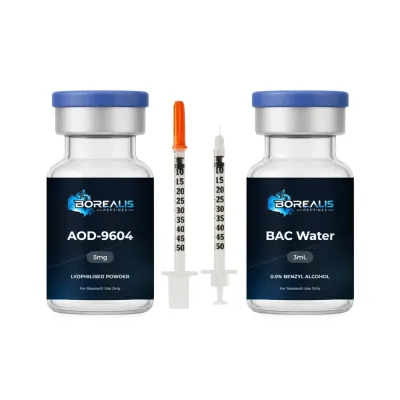
Buy AOD-9604 in Canada in a 5mg vial and a starter kit. Prices are in Canadian dollars, you pay by Interac e-Transfer or bank transfer, and orders are shipped from Canadian stock.
| Size | Price | Per mg |
|---|---|---|
| 5 mg | $57.00 | $11.40/mg |
Starter kit
Is AOD-9604 available in Canada?
AOD-9604 does not appear in the Drug Product Database as an authorized product. No regulatory assessment of its safety, efficacy or quality has been carried out in Canada. Borealis Peptides holds it for in-vitro research; it is not supplied for use in any living subject. How Health Canada treats research peptides →
Side effects reported in studies
The studies cited below report what they observed on tolerability, and those statements are reproduced as written. Animal and cell work of this size does not establish a safety profile. Read more →
Doses used in studies
AOD-9604 FAQ
What is AOD-9604?
AOD-9604 is a modified C-terminal fragment of human growth hormone, and that classification is where the published work starts. The published work on it is in rat, mouse, rabbit and in vitro. Borealis Peptides supplies it as lyophilised powder in 5 mg vials for in-vitro laboratory research. It is not a medicine and is not for use in humans or animals. Every reference here is listed with the model it ran in and the finding as published.
Where can I buy AOD-9604 in Canada?
It ships within Canada from stock we hold, in 5 mg vials. Nothing leaves without HPLC confirmation of identity and purity for that batch. Borealis Peptides accepts research orders only, and ships to research and business addresses. Identity and purity are checked per batch, and the paperwork names that batch specifically.
Is AOD-9604 legal in Canada?
AOD-9604 does not appear in the Drug Product Database as an authorized product. No regulatory assessment of its safety, efficacy or quality has been carried out in Canada. Borealis Peptides holds it for in-vitro research; it is not supplied for use in any living subject. Health Canada has said that "Research Use Only" labelling does not make a product legal to use in a person, so we treat it as a description of what the material is supplied for rather than a permission.
How much AOD-9604 should I use?
We do not answer dosing questions. AOD-9604 is not supplied for use in a person or an animal, so there is no dose to describe. What this page carries is the amount each cited study used and the model it used it in, reproduced as the authors published it.
Has AOD-9604 been tested in people?
No. The 6 studies cited here used animals or cell culture. There is no published human study of AOD-9604, so there is no evidence about what it does in a person, and this page makes no claim about that. The animal work is listed with its model so it can be read for what it is.
Does AOD-9604 need refrigeration?
The dry powder sits at −20 °C, shielded from light. Solutions are held at 2–8 °C. The lyophilised powder tolerates ambient temperature in transit, so it ships without ice and goes into the fridge on arrival. Repeated freeze-thaw cycles and light exposure are the real risks, not the shipping.
How is the purity of AOD-9604 confirmed?
Identity and purity are confirmed by HPLC for each batch, not once per product. The certificate names the batch it belongs to, and that batch number is on the vial, so a result can be traced back to the exact material that produced it. Ask with your order number and we send it.
How does AOD-9604 compare with 5-Amino-1MQ and MOTS-C?
They are different compounds with different published records, and this site does not rank them. 5-Amino-1MQ and MOTS-C have 7 cited studies and 7 cited studies on their page against 6 here. Set the two evidence tables side by side and the difference is visible directly.
Why is AOD-9604 named in a Health Canada advisory?
Because it was among the peptides seized from sellers offering unauthorized injectable products online. The advisory concerns material sold for people to inject without authorization. Borealis Peptides supplies research material for laboratory use and sells nothing for injection or for any use in a person, which is the line that advisory draws.
Compare with
Related compounds
5-Amino-1MQ
Small-molecule nicotinamide N-methyltransferase (NNMT) inhibitor
Add 2 more to save 4%
SLU-PP-332
Synthetic pan-ERR (ERRα/β/γ) agonist, small molecule
Add 2 more to save 4%
Tesamorelin
Growth hormone-releasing hormone (GHRH) analogue
Add 2 more to save 4%